• About
    • Our Team
    • Location
    • Industry Case Studies
    • Mission & Values
    • Corporate Responsibility
    • Vendor Management
    • History
    • Contact
  • Industries
    • Agribusiness
    • Food & Beverage
    • Metals & Steel
    • Mining, Aggregate, & Concrete
    • Oil & Gas
    • Paper
    • Power Generation & Energy
    • Water & Wastewater
    • Wind Services
  • Products
    • Type
    • Manufacturers
    • Asset Management Program
  • Generators
  • Remanufacture
    • Electrical Repairs
    • Mechanical Repairs
    • Machining
  • Field Services
    • All Services
    • Installation and Commissioning
    • Overhead Crane & Hoist Services
    • Wireless Equipment Condition Monitoring IoT
    • Predictive & Preventative
      • Vibration Analysis
      • On-Site Electrical Testing
      • Large AC and DC Motor PM and Repair
      • Gear Reducers
      • Precision Laser Alignment
  • Asset Management
    • Asset Management Program
    • Transport & Logistics
  • Careers
  • Login

Decatur Industrial Electric

Contact Us

Service & Quotes: 217-428-6621

You are here: Home / Archives for 2019

Archives for 2019

Motor Magnetic Center

Running a motor uncoupled will pull the motor rotor into a magnetic center, often marked on the shaft to ensure that the rotor is lined up on the magnetic center when it is coupled to the load. Axial misalignment of a coupling can occur if the coupling ends are not close enough when they are bolted together resulting in pulling the rotor out of magnetic center. When this happens the rotor is constantly trying to pull itself through axial thrusting back to magnetic center and could result in uneven and or excessive bearing wear. Using the EMAX technology you can evaluate the 5th harmonic peak as an indicator of this magnetic center offset and axial movement. Normally the 5th harmonic is a single clean peak in the current spectrum. However, if axial thrusting is occurring the 5th harmonic will split into two smeared peaks.

To see an example and hear a case study on a suspect magnetic center offset visit the PdMA YouTube Channel at https://www.youtube.com/watch?v=Mh2Cx6yqviw
Filed Under: Uncategorized

Don’t Start that Motor!

Back in May of this year we discussed the importance of Quality Control testing of your new or refurbished electric motors. Today we have a case study showing the importance of Quality Control testing for a newly commissioned system. All too often a new or refurbished motor gets installed and started on looks alone with no pre-qualifying data to justify the asset’s health. Where was the motor stored? How was the motor shipped? Were the power leads (Power Circuit) connected properly? Is the voltage supply balanced? Is the motor properly engineered and specified for the application? These are just a few questions that a good Quality Control program and testing plan will be able to answer. For MCEMAX® users, a three minute test will give qualifying baseline information about the motor to compare to industry standards and support an acceptance decision. And remember, for any newly installed motor, don’t start the motor unless the electric motor reliability team is on site to perform In-Rush/Start-Up testing on the motor when it first starts. This start-up data is crucial in qualifying the power quality, power circuit, stator, rotor and air gap. Additionally, it gives you critical comparison data for future troubleshooting efforts involving this motor and its application.

To see a new case study on the results of missing a quality control test, view the PdMA YouTube channel at:

https://www.youtube.com/watch?v=2Wp2nwOwxeY

Filed Under: Uncategorized

Converting motors from horizontal mount to vertical mount

Examine mechanical factors that should be considered when applying a horizontal ball-bearing motor in a vertical mounting position.

By Tom Bishop, P.E., EASA

Oct 08, 2019

Occasionally an end user wants to take a motor designed for horizontal mounting and use it in a vertical position. (Figure 1 illustrates a horizontal motor in a vertical shaft down position.) This article addresses some of the key mechanical factors that should be considered when applying a horizontal ball-bearing motor in a vertical mounting position.

These key factors include:

  • Axial thrust load capacity of bearing supporting rotor weight
  • Rotor weight
  • Weight of output shaft attachments
  • Axial thrust from direct-connected driven equipment\
  • Bearing lubrication paths
  • Bearing lubricant retention
  • Shaft up or shaft down orientation
  • Ingress protection
  • Locking axial thrust bearing

Click here to read the rest of the article from Plant Services

Filed Under: Uncategorized

Career Opportunity: Director of Strategic Accounts

Read the job description. 

Filed Under: Uncategorized

Customer Discontinuing Coal to Steam Operations

Decatur Industrial Works on Environmentally Friendly Retrofit & Upgrade

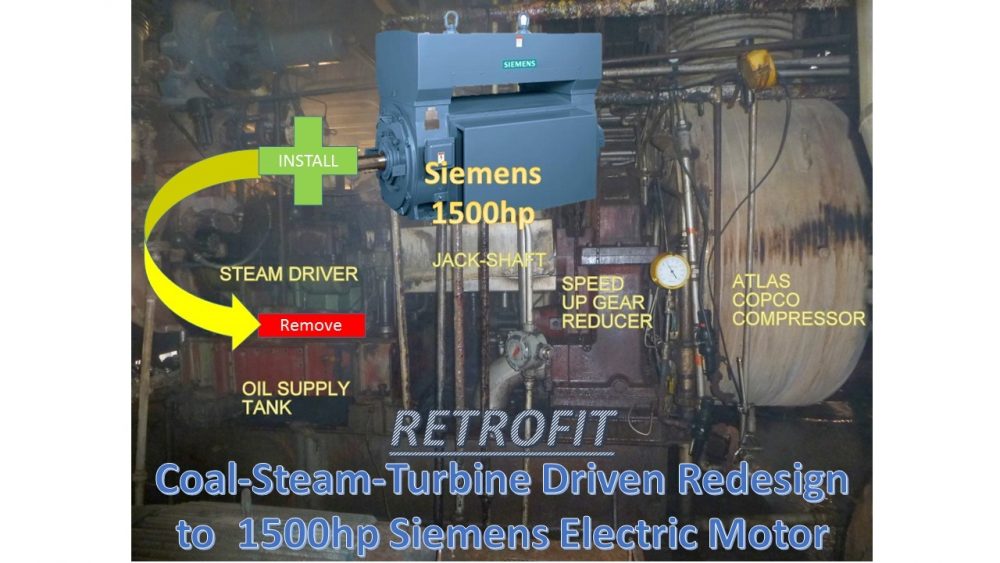
In an effort to go green, our customer’s facility is shutting down coal to steam operations. They have an MR compressor application that is driven by a steam turbine.  The process engineering team requested our assistance with motor application expertise and guidance in retrofitting to an electric motor driven solution for the existing compressor.

D.I.E collaborated with the customer’s engineering team on a motor and mounting adapter base solution to the existing compressor frame.   This solution needed to reliably function in a somewhat challenging environment.  We strategized in a team effort arriving at an adapter base and motor design that provided the required torque within the challenging thermal and dimensional limits available.  We determined that this application would require a 1500hp motor torque requirements with a very specialized adapter base.  The adapter base and motor will be built by the Siemens Above-NEMA (ANEMA) motor plant in Norwood, OH.  (story continues below picture.)


This upgrade will maximize their process efficiencies. Steam turbines are less efficient, compared to electric drive systems.  This is especially true when heat losses from steam are considered. Steam turbines also require more planned shutdowns, and due to their significant number of moving parts, are comparatively less reliable than electric motor drive systems. These advantages combine to maximize the customer’s equipment uptime and productivity.

Decatur Industrial would love to help your facility see what productivity gains you can achieve through similar upgrades.  Thanks to their efficiency, reliability, and attractive price points, electric motor variable speed drive systems are an attractive option.


Filed Under: TCO - Case Study

  • 1
  • 2
  • 3
  • …
  • 5
  • Next Page »

Archives

  • February 2026
  • October 2025
  • August 2025
  • June 2025
  • May 2025
  • April 2025
  • March 2025
  • February 2025
  • January 2025
  • November 2024
  • August 2024
  • June 2024
  • May 2024
  • April 2024
  • March 2024
  • January 2024
  • November 2023
  • October 2023
  • September 2023
  • August 2023
  • June 2023
  • May 2023
  • April 2023
  • February 2023
  • January 2023
  • December 2022
  • November 2022
  • October 2022
  • August 2022
  • July 2022
  • June 2022
  • May 2022
  • April 2022
  • March 2022
  • February 2022
  • January 2022
  • December 2021
  • November 2021
  • October 2021
  • September 2021
  • August 2021
  • July 2021
  • June 2021
  • April 2021
  • March 2021
  • February 2021
  • January 2021
  • December 2020
  • November 2020
  • October 2020
  • September 2020
  • August 2020
  • July 2020
  • June 2020
  • May 2020
  • April 2020
  • March 2020
  • February 2020
  • January 2020
  • December 2019
  • November 2019
  • October 2019
  • September 2019
  • August 2019
  • July 2019
  • June 2019
  • May 2019
  • April 2019
  • March 2019
  • February 2019
  • January 2019
  • December 2018
  • November 2018
  • October 2018
  • September 2018
  • August 2018
  • July 2018
  • June 2018
  • May 2018
  • April 2018
  • March 2018
  • February 2018
  • January 2018
  • December 2017
  • November 2017
  • October 2017
  • September 2017
  • August 2017
  • July 2017
  • May 2017
  • April 2017
  • March 2017
  • February 2017
  • January 2017
  • December 2016
  • November 2016
  • October 2016
  • September 2016
  • August 2016
  • July 2016
  • June 2016
  • May 2016
  • April 2016
  • March 2016
  • January 2016
  • December 2014
  • November 2014

Copyright © 2026 Decatur Industrial Electric - 217-428-6621