• About
    • Our Team
    • Location
    • Industry Case Studies
    • Mission & Values
    • Corporate Responsibility
    • Vendor Management
    • History
    • Contact
  • Industries
    • Agribusiness
    • Food & Beverage
    • Metals & Steel
    • Mining, Aggregate, & Concrete
    • Oil & Gas
    • Paper
    • Power Generation & Energy
    • Water & Wastewater
    • Wind Services
  • Products
    • Type
    • Manufacturers
    • Asset Management Program
  • Generators
  • Remanufacture
    • Electrical Repairs
    • Mechanical Repairs
    • Machining
  • Field Services
    • All Services
    • Installation and Commissioning
    • Overhead Crane & Hoist Services
    • Wireless Equipment Condition Monitoring IoT
    • Predictive & Preventative
      • Vibration Analysis
      • On-Site Electrical Testing
      • Large AC and DC Motor PM and Repair
      • Gear Reducers
      • Precision Laser Alignment
  • Asset Management
    • Asset Management Program
    • Transport & Logistics
  • Careers
  • Login

Decatur Industrial Electric

Contact Us

Service & Quotes: 217-428-6621

Crane and Hoist: Functional Test Inspection

Before every shift, the functionality of your crane must be tested. According to OSHA you need to visually test the following on a daily basis:

  1. The functional operating mechanisms for maladjustment interfering with proper operation;
  2. Deterioration or leakage in lines, tanks, valves, drain pumps and other parts of air or hydraulic systems;
  3. Hoist chains, including end connections, for excessive wear, twist, distorted links interfering with proper function, or stretch beyond manufacturer’s recommendations. This step also requires a monthly inspection with a certification record which includes the date of inspection, the signature of the person who performed the inspection, and an identifier of the chain which was inspected;
  4. Hooks with deformation or cracks. Like hoist chains, this also requires monthly inspection with a certification record which includes the date of inspection, the signature of the person who performed the inspection and the serial number, or other identifier, of the hook inspected;
  5. All functional operating mechanisms for excessive wear of components; daily to monthly intervals and
  6. Rope reeving for noncompliance with manufacturer’s recommendations, on a daily or monthly interval.
Filed Under: Crane & Hoist

Tip: Current Imbalance

Current Imbalance is a measure of the largest deviation in current between phases.  A current imbalance may be indicative of a high resistance connection. A voltage and current imbalance together is a more reliable indicator. Test location determines whether both imbalances are present in the event of a high resistance connection.  If the test is performed upstream of an anomaly, there will only be a current imbalance.  If the test is downstream of the anomaly, both a current and voltage imbalance will exist.  Parallel components such as power factor correction capacitors in the power circuit may also cause a current imbalance.  Testing needs to be performed with and without the parallel components in the system being tested to eliminate them as the cause of the current imbalance.

To read more or download the PDF visit our friends at PdMa. 


Filed Under: Electric Motors

What is L10 Life?

DID YOU KNOW? L10 life is the number of revolutions or hours that 90% of a group of apparently identical bearings will complete or exceed before fatigue is expected to occur. In other words, 10% of the group is not expected to achieve the L10 life.

Filed Under: Electric Motors

Decatur Industrial Electric Announces Richard Brunner as Director of Strategic Accounts

Rich BrunnerDecatur Industrial Electric is pleased to welcome Richard “Rich” Brunner as an addition to its Leadership Team. Brunner is an accomplished sales executive with over 20 years of experience in leading high-performance teams and developing valued partnerships with customers.  Rich was a D.I.E. team member approximately 20 years ago at the beginning of his career on the inside and outside sales team.

Rich is coming to us from Nidec Corporation (US Motors) where he was a sales manager over large capital projects. In his new role, Brunner will have primary responsibility for leading our team of reliability specialists/account managers in the Midwest and partnering with customers to understand their business needs and objectives.

Rich is originally from Oakley, IL, where his roots in the electrical industry date back to his father, a IBEW 146 electrician. Rich is a National Guard Veteran. He currently lives outside Champaign, with his wife of 26 years, where they are raising a small herd of black angus beef cattle.

Filed Under: Employee Higlights, General News

Winter Weather Considerations

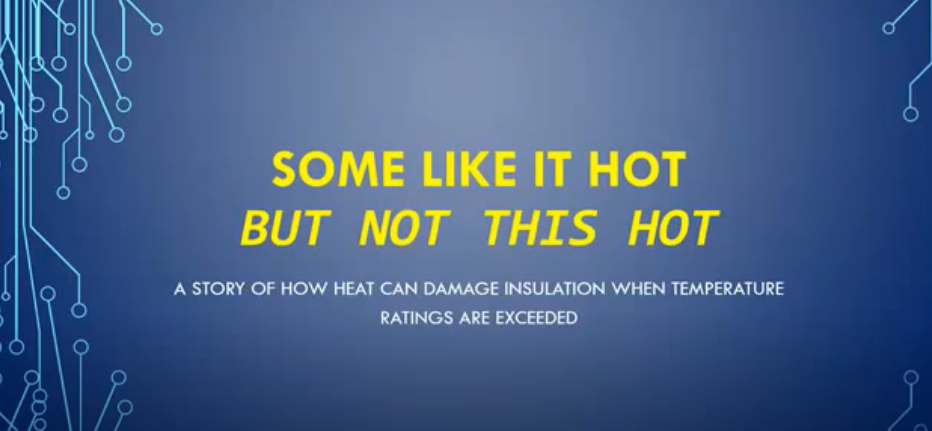
Even in the winter months a motor can overheat. Especially if snow or ice covers the air vents and prevents air from circulating on open drip proof designs. Motors running at design temperature should have an average insulation life expectancy of 20,000 running hours. Running motors hotter than design will reduce insulation life and running motors cooler than design will increase insulation life.

Not all motors have the luxury of being installed into a nice cool winter environment, so a review of the design temperature is important. Most motors have an ambient temperature rating of 40°C and an insulation class (A,B,F or H) listed on the motor nameplate. If your motor nameplate says insulation class B you can open your Electrical Engineering Pocket Handbook by EASA and see the temperature rating for Class B insulation is 130°C. So how does 130°C insulation rating and 40°C ambient temperature rating relate? Well, this means that if you start your motor with an ambient (outside air) temperature of 40°C, the internal insulation temperature should not exceed the insulation rating of 130°C. In a T-Frame Totally Enclosed Fan Cooled motor with Class B insulation an 80°C temperature rise is expected. Temperature Rise is the differential temperature from the ambient temperature and the internal winding temperature. So at full load and 40°C ambient with an 80°C rise, the surface temperature could reach 120°C (40°C+80°C). The 10°C difference (120°C vs. 130°C) is for hot spot allowance that may occur deep in the stator winding slots.

Even in winter months don’t be too quick to test the surface temperature of your motor with a bare hand. Surface temperature depends on many cooling design factors, but for a standard T-Frame motor, surface temperatures may reach as high as 95°C (203°F) and still be considered normal. Ouch! So don’t let snow and ice cover air vents and do be careful what you touch.

To see what happens to overheated insulation visit the PdMA YouTube Channel at: https://www.youtube.com/watch?v=Vt0cO1jHnKA 

Source: PdMA

Filed Under: Electric Motors

  • « Previous Page
  • 1
  • …
  • 10
  • 11
  • 12
  • 13
  • 14
  • …
  • 39
  • Next Page »

Archives

  • March 2026
  • February 2026
  • October 2025
  • August 2025
  • June 2025
  • May 2025
  • April 2025
  • March 2025
  • February 2025
  • January 2025
  • November 2024
  • August 2024
  • June 2024
  • May 2024
  • April 2024
  • March 2024
  • January 2024
  • November 2023
  • October 2023
  • September 2023
  • August 2023
  • June 2023
  • May 2023
  • April 2023
  • February 2023
  • January 2023
  • December 2022
  • November 2022
  • October 2022
  • August 2022
  • July 2022
  • June 2022
  • May 2022
  • April 2022
  • March 2022
  • February 2022
  • January 2022
  • December 2021
  • November 2021
  • October 2021
  • September 2021
  • August 2021
  • July 2021
  • June 2021
  • April 2021
  • March 2021
  • February 2021
  • January 2021
  • December 2020
  • November 2020
  • October 2020
  • September 2020
  • August 2020
  • July 2020
  • June 2020
  • May 2020
  • April 2020
  • March 2020
  • February 2020
  • January 2020
  • December 2019
  • November 2019
  • October 2019
  • September 2019
  • August 2019
  • July 2019
  • June 2019
  • May 2019
  • April 2019
  • March 2019
  • February 2019
  • January 2019
  • December 2018
  • November 2018
  • October 2018
  • September 2018
  • August 2018
  • July 2018
  • June 2018
  • May 2018
  • April 2018
  • March 2018
  • February 2018
  • January 2018
  • December 2017
  • November 2017
  • October 2017
  • September 2017
  • August 2017
  • July 2017
  • May 2017
  • April 2017
  • March 2017
  • February 2017
  • January 2017
  • December 2016
  • November 2016
  • October 2016
  • September 2016
  • August 2016
  • July 2016
  • June 2016
  • May 2016
  • April 2016
  • March 2016
  • January 2016
  • December 2014
  • November 2014

Copyright © 2026 Decatur Industrial Electric - 217-428-6621