• About
    • Our Team
    • Location
    • Industry Case Studies
    • Mission & Values
    • Corporate Responsibility
    • Vendor Management
    • History
    • Contact
  • Industries
    • Agribusiness
    • Food & Beverage
    • Metals & Steel
    • Mining, Aggregate, & Concrete
    • Oil & Gas
    • Paper
    • Power Generation & Energy
    • Water & Wastewater
    • Wind Services
  • Products
    • Type
    • Manufacturers
    • Asset Management Program
  • Generators
  • Remanufacture
    • Electrical Repairs
    • Mechanical Repairs
    • Machining
  • Field Services
    • All Services
    • Installation and Commissioning
    • Overhead Crane & Hoist Services
    • Wireless Equipment Condition Monitoring IoT
    • Predictive & Preventative
      • Vibration Analysis
      • On-Site Electrical Testing
      • Large AC and DC Motor PM and Repair
      • Gear Reducers
      • Precision Laser Alignment
  • Asset Management
    • Asset Management Program
    • Transport & Logistics
  • Careers
  • Login

Decatur Industrial Electric

Contact Us

Service & Quotes: 217-428-6621

Tech Tip: Oil Level of Vertical Machines


The sight glass of vertical machines has two marks, either marked as “Min” and “Max” or “Standstill” and “Running.” Sometimes, as shown in Figure 1, it’s not marked at all. There is much confusion about how to interpret these levels, and the motor manufacturer manuals are consistently vague. 


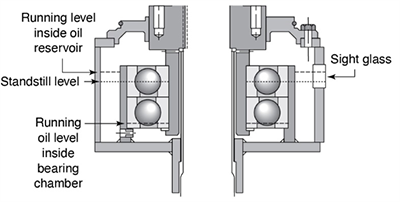
Unlike the dipstick in an automobile engine, the marks are not indicative of a safe range. The cutaway view of Figure 2 helps clarify how we should view those levels. The higher mark, whether it is labeled “Max” or “Running,” is the oil level we should see when the motor is running.  


As Figure 2 indicates, oil inside the bearing chamber is metered to avoid flooding the bearings during operation, which results in a higher oil level at the sight glass. 


The lower mark, “Min” or “Standstill,” is the oil level when the motor is not running. The oil seeks its own level, partially flooding the bearings within the inner chamber, to protect the bearings against corrosion. 


If we carry this understanding a step further, a running motor with oil level at the lower mark means the standstill oil level will be even lower – by the distance separating those two marks. Worse still, a non-rotating motor with oil level at the upper mark is actually overfilled, and the running level will increase by the distance between those two marks. In that case, an oil leak is very likely to occur when the motor is running.  For more valuable resources, check out the EASA Resource Library
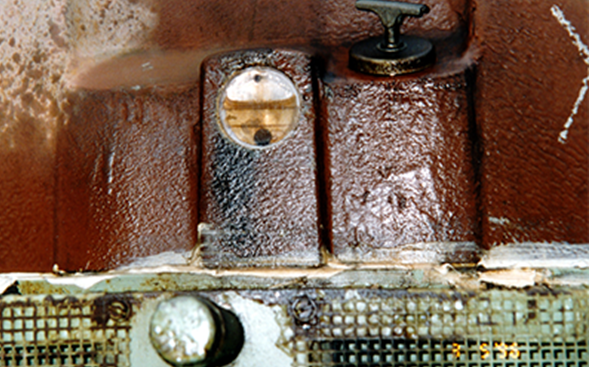
Figure 1
Figure 2


Filed Under: General News

NEMA Motor 101 Training Event

When: Wednesday, May 4th
Time: 9 AM to 2 PM CST
Where: Decatur Industrial Electric, 1650 E. Garfield Ave. Decatur, IL
Cost: No Charge!

Lunch will be provided. Plant tours during lunch break!

Jeff Meyer, Director of Industrial Solutions, takes the participants through various items, such as:

  • How does a motor run?
  • History of NEMA motors
  • Enclosures
  • Nameplate designations
  • NEMA vs IEC Motors
  • Variable frequency nameplates
  • And more

Limited spots available. 


Filed Under: General News, Training and Events

Decatur Industrial Electric Welcomes New Regional Reliability Manager

GregHiteDecatur Industrial Electric is pleased to announce Greg Hite has joined the company as Regional Reliability Manager. Hite is an accomplished sales manager specializing in distribution sales, service, remanufacturing of AC & DC motors, gearboxes and other rotating equipment, custom controls and manufacturing.
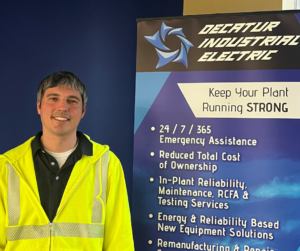
“Greg’s comprehensive industry knowledge and successful track record adds to our commitment to provide world-class electro-mechanical solutions,” said Trent Thompson, President of Decatur Industrial Electric. “We are excited to have him on board as we continue to grow and expand in order to support our customer base.”

Decatur Industrial Electric is a strategic partner in reliability solutions to customers throughout the Midwest, providing electrical and mechanical equipment solutions. For more information, visit decaturindustrial.com

Filed Under: Employee Higlights, General News

Fault Zone Series: Part 1 Power Quality

Sticking to the Fault Zone approach to electric motor troubleshooting we are starting this series with Power Quality. “You are what you eat,” is what you were told as a child when your parents were trying to get you to eat healthy foods. Well, the same is true for your electric motor. The motor’s health is based in part on whether you feed it good clean power quality. Many electric motor fault zones are related to heat and Power Quality is no different. Poor power quality makes a motor work harder than designed to deliver the horsepower required by the load. A 100HP motor with poor power quality may require 110HP worth of current to deliver the requested 100HP. This extra current increases the heating of a motor beyond its design temperature and will reduce the life of the motor. Identifying power quality issues like excessive harmonics and voltage imbalances early will allow you to reduce the load of a motor when possible until you can correct the issues and extend the life of your motor. For more examples of Power Quality anomalies and Power Quality standards applied to your electric motor reliability visit MCEMAX Fault Zone- Power Quality on the PdMA YouTube Channel.

Filed Under: Electric Motors, Electrical Testing, General News

Meet Steven Leinard – Manager of Quality and Engineering

Decatur Industrial is pleased to announce that Steven Leinard has the joined the team as the Manager of Quality and Engineering. This is an integral role in serving out our promise of exceptional service and quality to customers.

This position is a natural fit for Leinard, coming to Decatur Industrial with a background in management in regulated industries such as pharmaceutical, bulk foods, bulk ingredients, and the US Navy.

“We have an established quality system that I am looking forward to overseeing and improving upon,” said Leinard. “Consistently working to improve our operations and processes is something I am very passionate about.”

Filed Under: Employee Higlights, General News

  • « Previous Page
  • 1
  • …
  • 7
  • 8
  • 9
  • 10
  • 11
  • …
  • 39
  • Next Page »

Archives

  • March 2026
  • February 2026
  • October 2025
  • August 2025
  • June 2025
  • May 2025
  • April 2025
  • March 2025
  • February 2025
  • January 2025
  • November 2024
  • August 2024
  • June 2024
  • May 2024
  • April 2024
  • March 2024
  • January 2024
  • November 2023
  • October 2023
  • September 2023
  • August 2023
  • June 2023
  • May 2023
  • April 2023
  • February 2023
  • January 2023
  • December 2022
  • November 2022
  • October 2022
  • August 2022
  • July 2022
  • June 2022
  • May 2022
  • April 2022
  • March 2022
  • February 2022
  • January 2022
  • December 2021
  • November 2021
  • October 2021
  • September 2021
  • August 2021
  • July 2021
  • June 2021
  • April 2021
  • March 2021
  • February 2021
  • January 2021
  • December 2020
  • November 2020
  • October 2020
  • September 2020
  • August 2020
  • July 2020
  • June 2020
  • May 2020
  • April 2020
  • March 2020
  • February 2020
  • January 2020
  • December 2019
  • November 2019
  • October 2019
  • September 2019
  • August 2019
  • July 2019
  • June 2019
  • May 2019
  • April 2019
  • March 2019
  • February 2019
  • January 2019
  • December 2018
  • November 2018
  • October 2018
  • September 2018
  • August 2018
  • July 2018
  • June 2018
  • May 2018
  • April 2018
  • March 2018
  • February 2018
  • January 2018
  • December 2017
  • November 2017
  • October 2017
  • September 2017
  • August 2017
  • July 2017
  • May 2017
  • April 2017
  • March 2017
  • February 2017
  • January 2017
  • December 2016
  • November 2016
  • October 2016
  • September 2016
  • August 2016
  • July 2016
  • June 2016
  • May 2016
  • April 2016
  • March 2016
  • January 2016
  • December 2014
  • November 2014

Copyright © 2026 Decatur Industrial Electric - 217-428-6621